
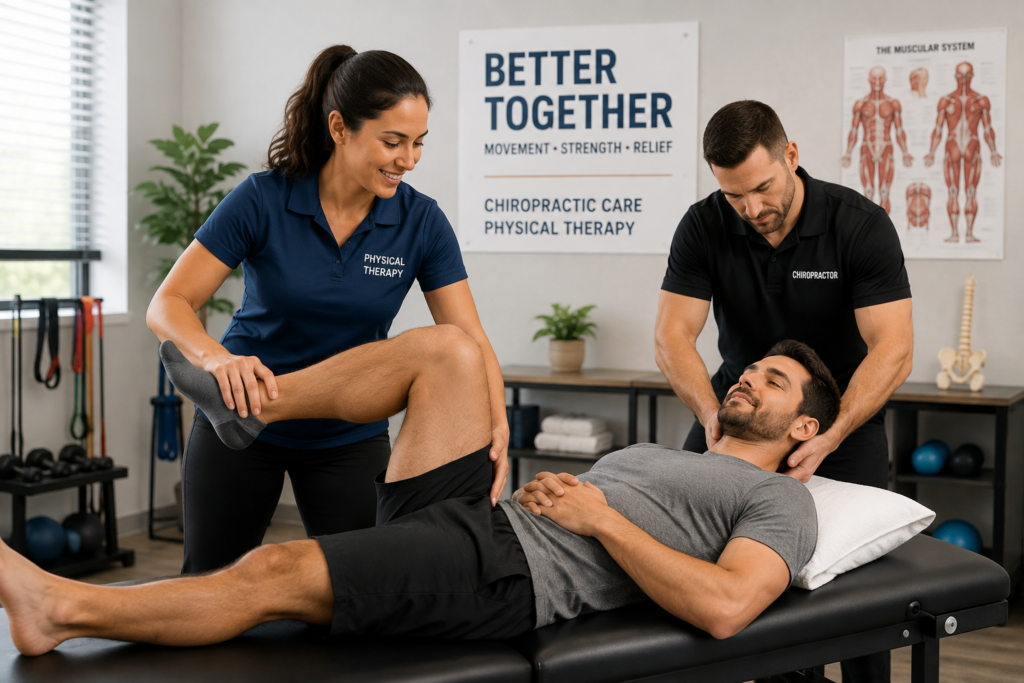
When pain or an injury limits the way you move, getting relief is important—but restoring strength, mobility, and function matters too. Chiropractic care and physical therapy approach musculoskeletal problems in different but complementary ways. For some patients, combining the two can provide a more complete rehabilitation plan that addresses both painful or restricted movement and the strength needed to return to everyday activities.
How Are Chiropractic Care and Physical Therapy Different?
Chiropractic care commonly focuses on musculoskeletal problems involving the spine, joints, muscles, and surrounding tissues. Depending on the patient’s condition, treatment may include spinal or joint manipulation, mobilization, soft-tissue techniques, and other conservative approaches intended to improve mobility and reduce musculoskeletal discomfort.
Physical therapy places greater emphasis on restoring movement and function through therapeutic exercise, strengthening, flexibility, balance, mobility training, and functional activities.
Although the two disciplines are different, their goals can overlap—and that is where combining them may be beneficial.
Why Combine the Two?
Consider a patient with lower back pain who has stiffness and restricted spinal movement but has also become weak or deconditioned because pain has limited activity. Addressing mobility alone may not fully restore the person’s ability to lift, bend, walk, work, or exercise comfortably.
Chiropractic treatment may help address appropriate joint and musculoskeletal restrictions, while physical therapy can progressively rebuild strength, flexibility, endurance, and movement patterns.
Together, the treatments can be coordinated around what the patient actually needs to do in daily life.
Treatment After an Injury
A combined approach may be particularly useful during rehabilitation from certain motor vehicle accidents, work injuries, sports injuries, or other musculoskeletal conditions.
For example, someone recovering from a car accident may initially have neck or back pain, muscle tightness, limited range of motion, and difficulty performing normal activities. As symptoms improve, physical therapy can progressively focus on strength, stability, endurance, and functional movement.
The exact combination of care should always depend on the patient’s diagnosis, examination findings, progress, and individual goals.
It’s Not One-Size-Fits-All
Not every patient needs both chiropractic care and physical therapy. Some conditions may respond well to one approach, while others may benefit from coordinated treatment involving several healthcare professionals.
A proper evaluation helps determine which treatments are appropriate and allows the treatment plan to change as the patient progresses. The goal isn’t simply to perform more treatment—it’s to provide the right treatment at the right stage of recovery.
A More Complete Approach to Recovery
At Easy Reach Chiropractic & Physical Therapy, having chiropractic and physical therapy services available allows us to address different aspects of musculoskeletal recovery under one coordinated treatment plan.
A More Complete Approach to Recovery
At Easy Reach Chiropractic & Physical Therapy, having chiropractic and physical therapy services available allows us to address different aspects of musculoskeletal recovery under one coordinated treatment plan.
Whether pain developed gradually or followed a motor vehicle accident, workplace injury, or other musculoskeletal condition, treatment can be tailored to help improve mobility, rebuild strength, restore function, and help patients return to the activities that matter to them.
Our Lake Worth and Fort Lauderdale locations provide individualized chiropractic care, physical therapy, and rehabilitation based on each patient’s needs and progress. South Florida communities.